
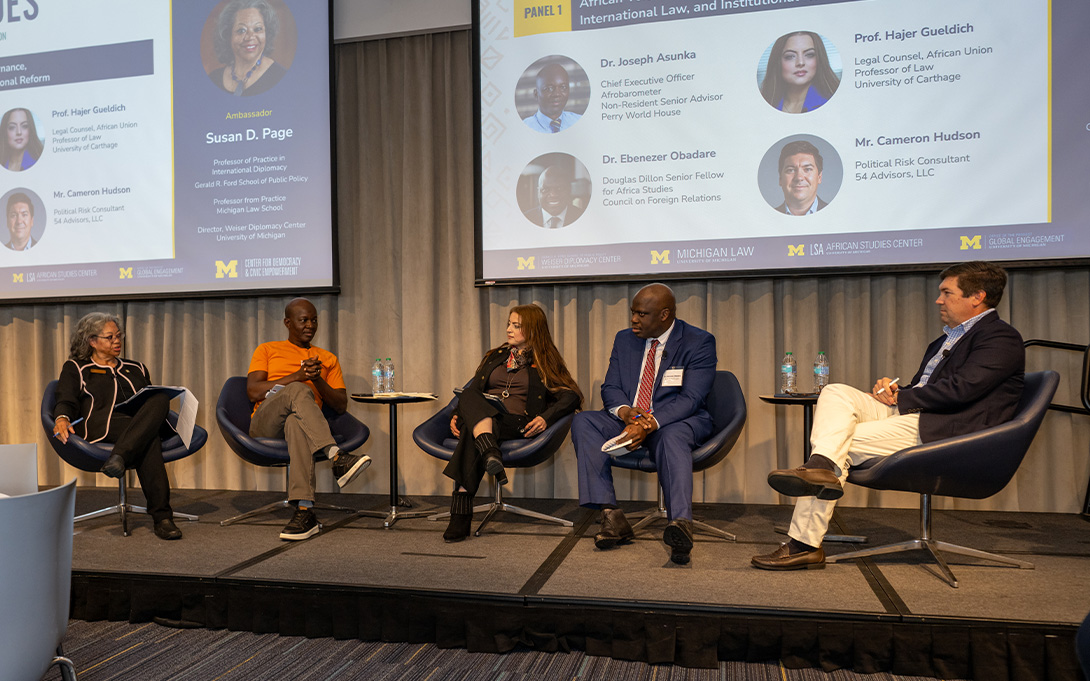
As global power dynamics shift and competition for influence intensifies, African nations' role in the international system is becoming increasingly consequential. In collaboration with University of Michigan Law School and the African Studies Center, the Ford School's Weiser Diplomacy Center's (WDC), recent conference, "Shifting Tides: The U.S.-Africa Relationship Amid Global Competition," brought together policymakers, researchers, and practitioners to discuss how African priorities, interests, and leadership are shaping evolving partnerships—and what this means for the future of U.S.–Africa relations.
Chidi Blyden, executive director of the Harvard Center for African Studies and former Deputy Assistant Secretary of Defense for African Affairs, opened the conference with a keynote address centered on Africa's ever-growing influence in the global order.

"Consider the forces reshaping the twenty-first century…demographic growth, artificial intelligence, energy transitions, supply chains, critical minerals, digital innovation, climate adaptation," said Blyden. "These are not the discussions that we were having previously when talking about Africa. Africa sits at the center of every one of these conversations."
Reflecting on her time as a U.S. government official, Blyden said that even with extensive planning and preparation dedicated to developing U.S.-African policy, African perspectives and input were often left out of the policymaking process.
"Too often, we approached Africa through frameworks developed without input from Africans themselves, and assumed that they would naturally fit into different African contexts," she said.
"Too often, I think we viewed Africa through the lens of our interests rather than through an understanding of Africans' own aspirations. And too often, we underestimated how rapidly the continent was changing, and we didn't have strong foundations on which to change with it."

From global governance to regional security and migration trends, students and U-M community members spent the next two days engaged in panel discussions across all areas of African policy and U.S.-African partnerships.
Ambassador Susan D. Page, WDC director and professor of practice at both the Ford School and Law School, said African nations have been making waves in global governance organizations. Led by African states and the African Union, two significant United Nations General Assembly (UNGA) resolutions recently passed with nearly unanimous support. Aimed at more accurately reflecting the enormous size of the entirety of the African continent, the "Correct the Map" Resolution in September highlighted the negative impact of the continued use of the Mercator map, long used to inaccurately depict the size of the world's continents. Another African-initiated UNGA resolution declared the transatlantic slave trade and racialized chattel enslavement as "the gravest crime against humanity." While resolutions are non-binding, they send a strong message to world leaders that Africa and Africans' voices matter.

"We have all witnessed dramatic changes in the past several years with numerous global actors challenging the very nature and structure of international institutions—such as the United Nations Security Council, the World Bank and IMF, the World Trade Organization, regional intergovernmental organizations and blocs such as the overlapping membership of African states in both the African Union and the League of Arab States," Page said.
Despite the growing role of African states in global institutions, Page noted the lack of strategic focus on the continent reflected in the 2025 U.S. National Security Strategy.
"It is a 29-page national security strategy, and the African continent is on page 29… it's in fact a short three paragraphs, focusing on [the] opening up of African markets to U.S. goods and supplies," Page said. "That's what the U.S. seems to think about Africa."

Ambassador Kamissa Camara, Ford School professor of practice and former foreign minister of the Republic of Mali—alongside Michigan Law professor Laura Beny, U-M School for the Environment and Sustainability professor Bilal Butt, and director of the U-M African Studies Center Omolade Adunbi—accompanied Page in moderating panels throughout the conference. Yousif Hassan, assistant professor at the Ford School and the U-M School of Information, participated as a panelist in a discussion on African environmental and climate governance, natural resource policy, and human capital development.

Celeste Watkins-Hayes, the Joan and Sanford Weill Dean of Public Policy at the Ford School, said the conference was a reflection of the Ford School's broader efforts to prepare students for contemporary policy challenges.
"At a moment of intensifying competition, African governments and institutions are defining their priorities and choosing their partnerships. Meaningful U.S. engagement requires credibility, consistency, and respect for African sovereignty," said Watkins-Hayes. "The trust built today will shape our ability to address shared challenges for years to come."
Camara closed the conference with a reflection on how policymakers should be approaching questions about U.S.-Africa relations.

"[F]or too long, conversations about this relationship have revolved around what the U.S. wants from Africa, what it can offer Africa, or how Africa fits into the broader American strategic priorities," she said.
"Perhaps it is time to devote equal attention to what African countries want from the U.S.—how they define their own interests and what kind of partnerships they are prepared to pursue."
The Ford School's Weiser Diplomacy Center, the U-M Law School, and the U-M African Studies Center co-organized the two-day conference, and the Office of the Provost, Global Engagement, and the Center for Democracy & Civic Empowerment co-sponsored it.
Panels included:
- African Voices on Global Governance, International Law, and Institutional Reform
- Climate, Innovation, and Human Capital: Navigating Africa's Green Transitions
- Migration, Peace and Security in an Age of Uncertainty
- Africa's Economic Future: Trade Integration, Investment, and Growth Pathways
- Geopolitics and Great Power Competition: Africa's Strategic Positioning
Watch the conference recordings here:
See the full list of panel speakers here.
View photos from the conference here.
More news from the Ford School