
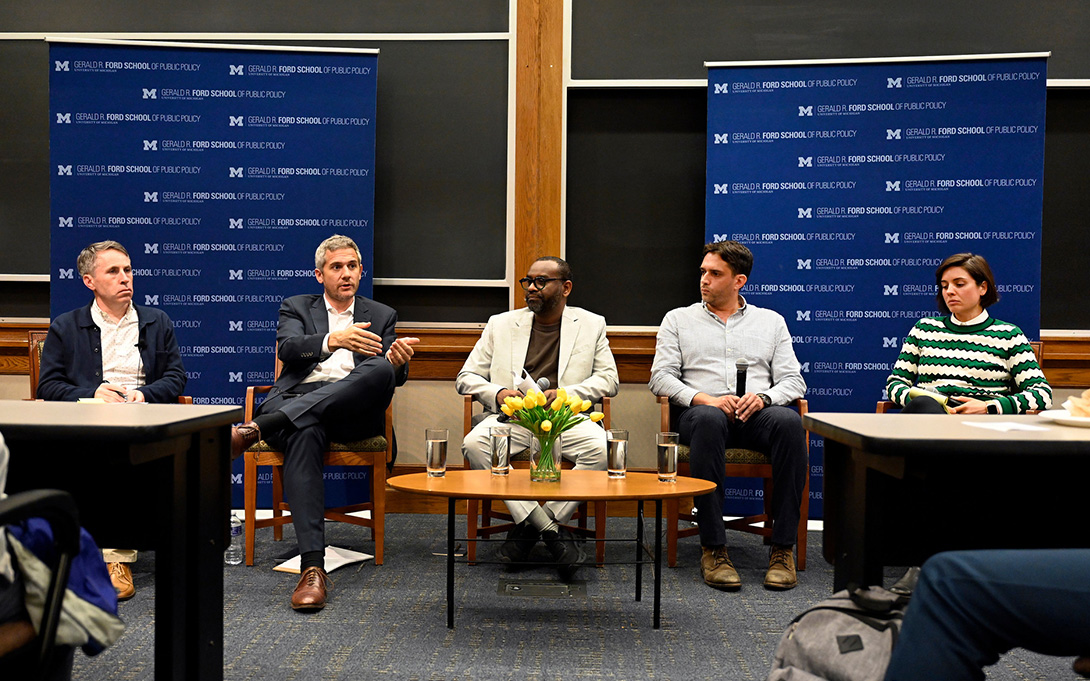
Where can we find solutions to global democratic backsliding? At a recent Ford School Democracy Week event, "Democracy in global-historical perspective," Don Moynihan, J. Ira and Nicki Harris Family Professor of Public Policy, moderated a discussion with Ford School faculty Megan Stewart, Yousif Hassan, and Yusuf Neggers, and Harvard Business School professor Vincent Pons. The panel considered what cross-national and historical research reveals about democratic resilience and erosion.
Pons focused on free and fair elections, arguing that representative outcomes depend partly on whether citizens can vote without unnecessary burdens. Registration requirements, travel, information costs, and election administration may appear procedural, he said, but can determine who participates.
"Sometimes small technical differences in the way elections are organized across countries lead to major differences in how democracy operates," Pons said, highlighting the broad architecture of electoral systems.
Ford School assistant professor Yusuf Neggers pointed to administrative practices that determine whether people can exercise their formal voting rights. Neggers studies electoral accountability, including the "frictions or burdens" voters may encounter, even after they are registered and officially eligible to vote. His research in India found that the discretion of polling-place officials can affect whether minority voters cast ballots, and that more diverse election teams and broad access to official voter identification could reduce disparities.
"Things that are seemingly small can matter in quite important ways," Neggers said.

Hassan, an assistant professor of public policy whose research examines technology governance and artificial intelligence in the Global South, offered a broader definition of democratic participation.
"Very often we tend to think about democracy in terms of institutions, political participation, mobilizations. But I look at democracy as really the capacity of people for collective self-governance," Hassan said.
His research places questions about artificial intelligence squarely within democratic politics: Who decides which technologies are developed? Whose knowledge and values guide them? Who owns the data, and who benefits?
Drawing on examples of youth organizing and protest in Sudan and Kenya, he argued that citizens may not be abandoning democracy so much as seeking new ways to shape public decisions when formal institutions are unresponsive.
"If we measure democracy only through elections and electoral cycles, we lose sight of a lot of other forms of participation on the ground," Hassan said. "People are not really losing faith in democracy—they're trying to rethink other ways of participating and influencing decision-making."
Stewart, an associate professor of public policy, placed democratic change within a longer history of conflict and institutional transformation. Her research examines how political violence—including civil war and anticolonial struggle—can create openings for expanded participation while also producing backlash.

"Merely because you have elections, and merely because you have participation, does not necessarily mean you're meaningfully changing outcomes," Stewart said. "The institutions alone are not enough."
Democratic practices and methods for undermining them also cross borders, she noted. "What happens in one place with respect to democracy is not always contained to that place. It ripples beyond that."
Moynihan closed the discussion by emphasizing that democracy relies on more than elections.
"Democracy is not just about voting—it's about the ways in which rights, opportunities, and status are maintained within a society," Moynihan said.
More news from the Ford School"Democracy is not just something given to us by government. It is something that is upheld and protected by individuals and civic institutions."