
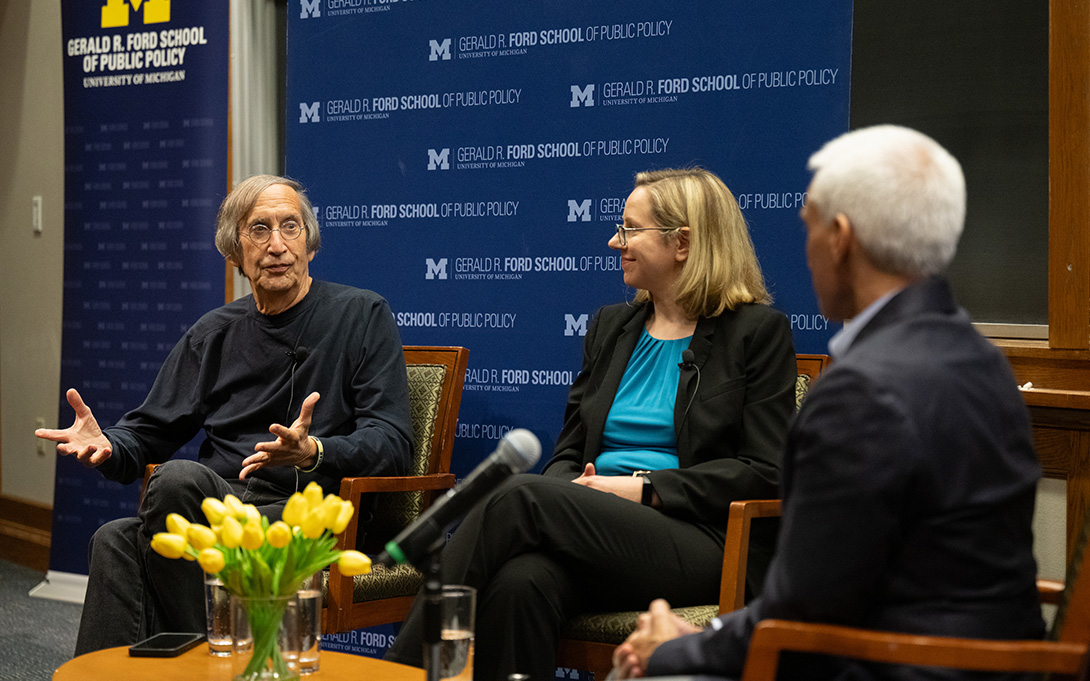
Ford School students engaged foreign policy experts on Iran, regional security, and the limits of U.S. power.

Saumya Nagar, a second-year student in the Ford School's three-year dual MBA/MPP program, put a direct question to the panel: once the United States exits the conflict with Iran, how could Tehran be persuaded to give up control of the Strait of Hormuz?
"They can't," answered Rosemary Kelanic, director of the Middle East program at Defense Priorities. "Even if they wanted to give it up, they couldn't credibly give it up, because the war has shown that you just don't need a lot of stuff to do these kinds of tactics." Even with a formal promise from Iran, she added, "nobody would believe them, because the geography and the military technology favor the attacker."
The exchange came near the end of an hour-long conversation on U.S. strategy in the Middle East, held as the U.S.-Iran war entered its eighth month and just after the third anniversary of the October 7 attacks on Israel. Kelanic was joined by Aaron David Miller, a senior fellow in the American Statecraft Program at the Carnegie Endowment for International Peace, who earned his PhD in Middle East and U.S. diplomatic history at the University of Michigan.
The October event was part of the Ford School's Conversations Across Differences series and was co-sponsored by the Weiser Diplomacy Center. Javed Ali, professor of practice at the Ford School and former senior director for counterterrorism at the National Security Council, moderated.
Wars of choice and existential stakes
Ali organized the discussion around three themes the panelists proposed: headlines, trend lines, and the impact of regional events in the United States. Asked to assess the region three years after October 7, Miller described a war "which overestimated America's military capacity and underestimated the very forces that have plagued American policy in the region for decades."

The central asymmetry, he argued, is one of stakes. "For the parties in this region, whether we choose to accept it or not, it's an existential conflict," Miller said. "For them, it's not a matter of discretion, it's a matter of existence," which gives regional actors a capacity "to take risks and absorb pain" far greater than Washington's.
Kelanic, speaking from a restraint-and-realism perspective, reached a similar conclusion by a different route. "We are an existential threat to Iran. Iran is an excursion for us," she said. "It's a war of choice and luxury for the United States in a way that it just is not, never will be, for Iran."
Despite their different backgrounds, both speakers argued that U.S. policy is constrained by a fundamental mismatch in commitment. Washington can choose when to disengage, while regional actors may believe they cannot.
A stalemate in the Gulf
On the trajectory of the U.S.-Iran conflict, both panelists saw little near-term room for diplomacy. Kelanic described a contested maritime standoff in which "the U.S. can't completely open the strait and Iran cannot completely close it," and predicted that a war risk premium on Gulf oil would persist "even if we get some kind of peace deal, which I think is very unlikely."
Miller pointed to geography as the factor that most separates American thinking from that of states in the region. With "non-predatory neighbors to our north and south" and oceans to the east and west, he said, Americans have developed an optimism and a pragmatism that lead them to assume every international problem has a solution. Citing the theologian Reinhold Niebuhr, he suggested that the best policymakers can usually do "is to come up with proximate solutions to insoluble problems."
Students in the conversation

Student discussants, all enrolled in Ali's cybersecurity and counterterrorism courses, led the audience question period. Liv VanEss, a first-year MPP student and graduate of U-M's College of Literature, Science, and the Arts, asked how the Mecca Joint Defense Agreement among Saudi Arabia, Pakistan, and Turkey might reshape conflicts in Yemen and beyond. Kelanic said regional actors taking more responsibility for their own security was "not necessarily a bad thing for the United States." Miller was more skeptical, describing a region "where no one's in charge." The more useful question, he said, is "what are American interests? Why do we even care about this region?"
Nagar's question on reported intelligence sharing among Iran, China, and Russia drew one of the afternoon's clearer disagreements: Miller called it "scandalous," while Kelanic described it as "balance of power politics," noting the United States does the same in Ukraine.
Kelanic left students with a question of her own: "What do you want American foreign policy in the region to be? Are you happy with where it is?"
More news from the Ford School